

NTU Achieves Record High of 54th in the 2027 QS World University Rankings


瀏覽器版本過舊,或未開啟 javascript
請更新瀏覽器或啟用 javascript
Spotlights


Date: Feb 22, 2023
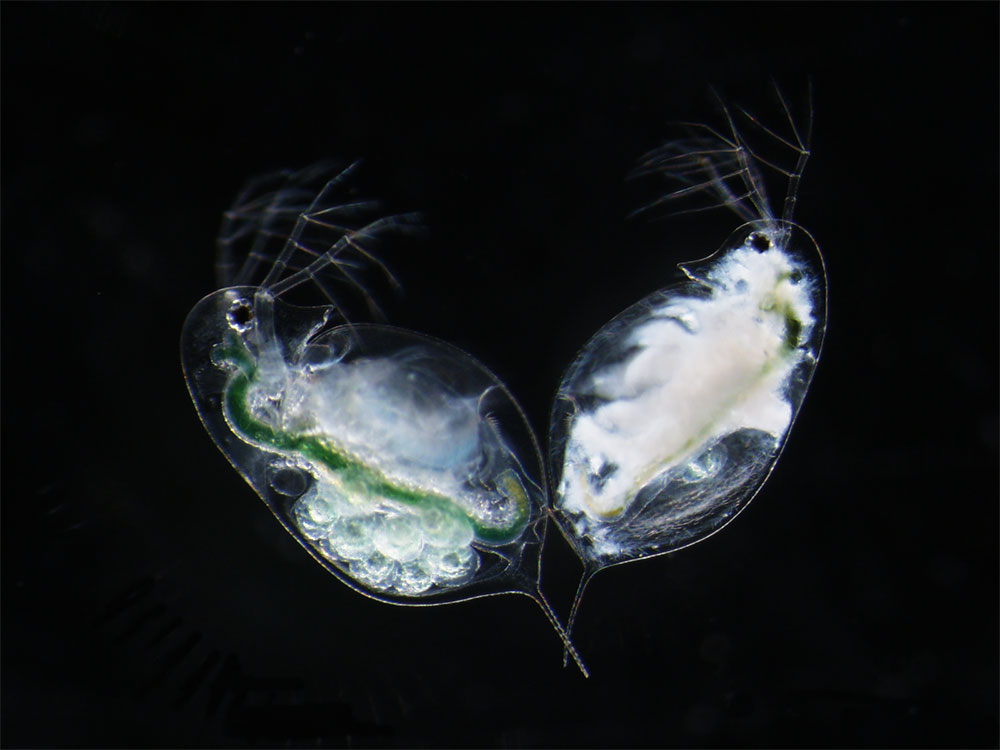
A comparison of a healthy (left) and an Metschnikowia bicuspidata-infected (right) Daphnia dentifera. Photo credit: Syuan-Jyun Sun.
One major concern related to climate change is that elevated temperatures will drive increases in parasite outbreaks. Increasing temperature is known to alter host traits and host-parasite interactions, but we know relatively little about how these are connected mechanistically-that is, about how warmer temperatures impact the relationship between epidemiologically relevant host traits and infection outcomes. Here, working together with the research team led by Prof. Meghan Duffy from University of Michigan, Prof. Syuan-Jyun Sun(孫烜駿) from the International Degree Program Climate Change and Sustainable Development used a zooplankton-fungus (Daphnia dentifera-Metschnikowia bicuspidata) disease system to experimentally investigate how temperature impacted physical barriers to infection and cellular immune responses. They found thatDaphnia reared at warmer temperatures had more robust physical barriers to infection but decreased cellular immune responses during the initial infection process. Infected hosts at warmer temperatures also suffered greater fecundity and lifespan reductions. Furthermore, the relationship between a key trait – gut epithelium thickness, a physical barrier – and the likelihood of terminal infection reversed at warmer temperatures. Together, their results highlight the complex ways temperatures can modulate host-parasite interactions and show that different defense components can have qualitatively different responses to warmer temperatures, highlighting the importance of considering key host traits when predicting disease dynamics in a warmer world.
Click the link to read the article: https://royalsocietypublishing.org/doi/10.1098/rstb.2022.0009
Visit Prof. Sun’s Lab Website: https://sites.google.com/view/sjsun
NTU Achieves Record High of 54th in the 2027 QS World University Rankings

2026 NTU Commencement

Southern Ocean "Intermediate Water" Holds the Key to Earth’s Carbon Dioxide Changes

NTU Team Achieves a Highly Cycle-Stable Zirconium Dioxide Antiferroelectric Technology Capable of 100 Million Cycles

Nobel Laureate in Chemistry Joachim Frank Unveils the Legendary Path of Cryo-Electron Microscopy in Transforming Modern Medicine
Current Spotlights
NTU Achieves Record High of 54th in the 2027 QS World University Rankings
2026 NTU Commencement
Southern Ocean "Intermediate Water" Holds the Key to Earth’s Carbon Dioxide Changes
NTU Team Achieves a Highly Cycle-Stable Zirconium Dioxide Antiferroelectric Technology Capable of 100 Million Cycles
Nobel Laureate in Chemistry Joachim Frank Unveils the Legendary Path of Cryo-Electron Microscopy in Transforming Modern Medicine
